Immediate
Nothing to configure and nothing to install into. Open it, put a sound on, and it is already running. The first noise you hear is one you chose.
Deep machines, played by hand.
Click anywhere to enter
Lancaster Sound Labs
Instruments and effects, made one at a time
Transform the sounds that surround you into a collage, an infinite drone, a shifting ambient sculpture. Control it simply by touching and moving a glowing orb, or dive deeper.
Field Lab is a field recorder and a sound design tool in one. Everything here is deep, and none of it is difficult.
The orb · one sound, held
The apparatus
Plates I–IV · what a recording passes through in Field Lab and Porta Lab
A place is taken down as it is: rain against glass, a room with its fridge running, dry leaves underfoot. Nothing is composed. The only intervention is a lift on the way in, so that a careful, quiet take does not arrive too faint to work with.
A bank of sympathetic strings, held beside the recording and set going by it. It feeds on accidents. Every click, pop and footfall in the source strikes the strings, and returns as a pitched burst that was always latent in the sound and never audible in it.
The interval is cut into hundreds of fragments and resown. Scattered loosely, the room becomes weather; drawn tight, single grains step forward one at a time, each one a hundredth of a second of somewhere real. Four engines read the same buffer by four different laws.
All of it lands on tape, and tape has opinions. Hiss, surface noise, the glue of a machine's own compression, and a single speed wobble shared by every channel, so that four separate things drift as one.
The instruments
Choose one to see it
Field Lab is here now. Porta Lab takes the same engines and gives four of them a desk.
Porta Lab
The desk · iPad
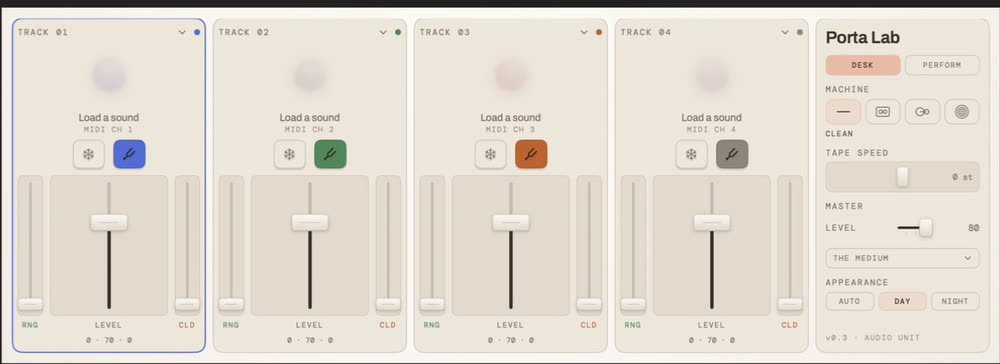
Above · the desk running as an Audio Unit in a session
Four channels, four colours. Blue, green, orange and grey, fixed, so you can tell them apart across a room.
The blends sit either side of the level. Resonator on the left, grains on the right: the two things you reach for most, under one hand.
Nothing is quantised. A twelve-second loop against a twenty-second loop goes round for a minute before it repeats itself.
Screens from the iPad build nearer release
Field Lab
iPhone · free · screens from the build
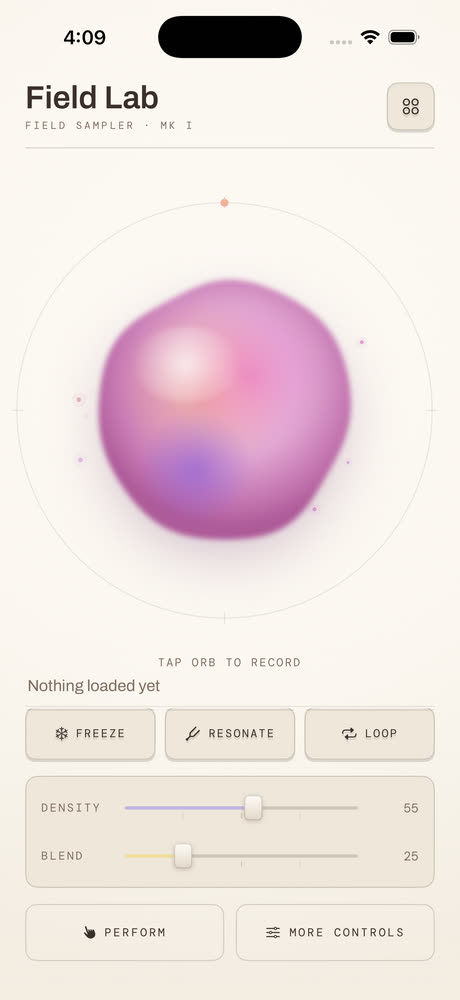
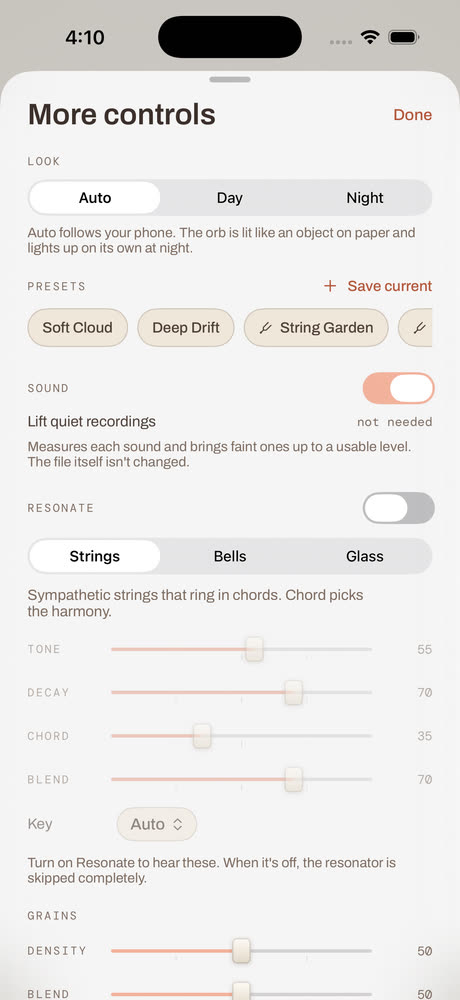
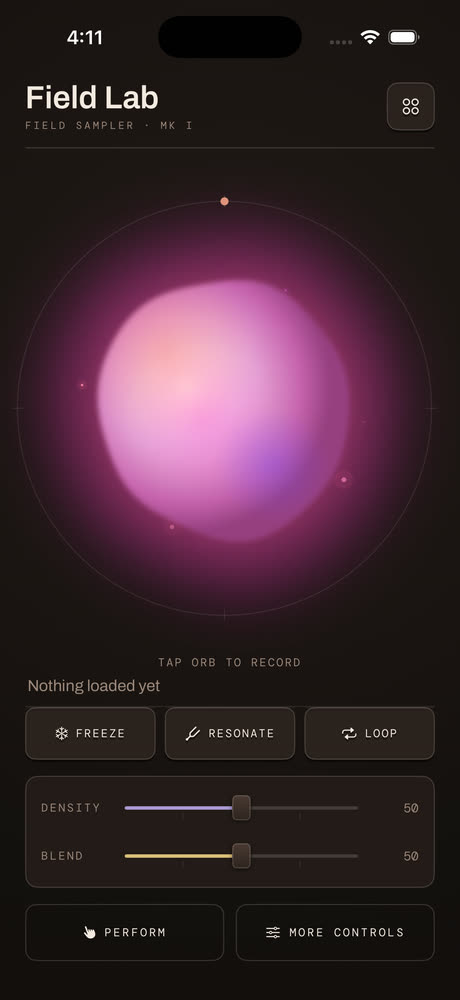
One screen to play from. Freeze, Resonate and Loop under the orb, density and blend beneath them. Everything deeper sits one tap behind More controls.
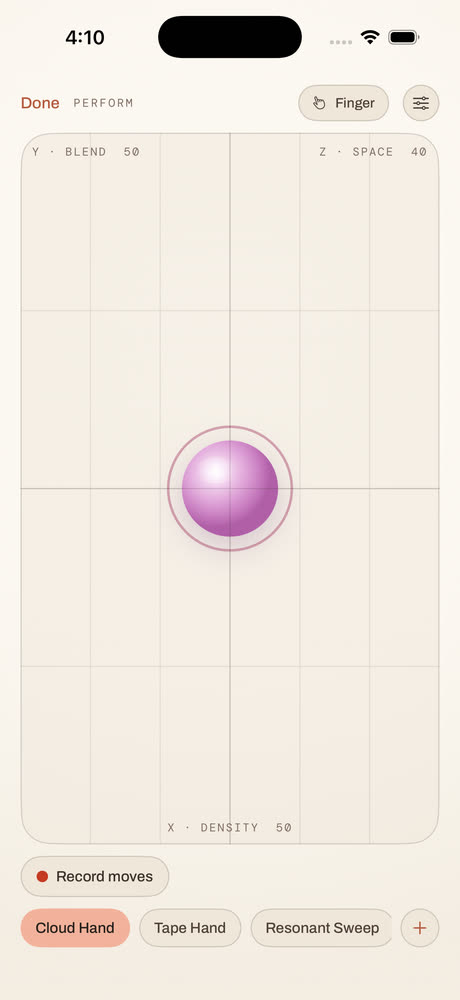
Three axes under one finger. The perform pad moves density, blend and space at once. Record the moves and they loop — Cloud Hand, Tape Hand, Resonant Sweep are saved gestures you can keep.
Three resonator voices. Strings, bells and glass, each tuned to the key of whatever is loaded, or pinned by hand.
A note on method
Nothing here is composed. Everything is found, and then persuaded to keep going.
The work is not writing a part. It is choosing a moment, deciding which of its accidents are worth amplifying, and then holding the whole thing open long enough to live inside.
Engines
The resonator and the granular engine are Mutable Instruments' Rings and Clouds, open-sourced under the MIT licence and carried over whole. Everything runs at 32 kHz, the rate the original hardware used.
Built in
Swift, C++ and JUCE, by one person. The same code draws the orb on the iPhone, the desk on the iPad, and the plug-in inside a recording session.
Starter sounds
Twenty recordings ship with the apps — beds to hold a chord, exciters to strike the strings, and places to sit inside. Bring your own and they behave the same way.